
A Family Saved From Financial Ruin: A Miracle of Grace
As a high-ranking executive in the life insurance industry, I was pretty far removed from the customer. I spent much more of my time interacting with agents and employees than with the families whose lives were ultimately affected by the decisions we made.
The most important direct interactions with customers occurred through the life insurance agent, who would make the initial sale, service the account, and ultimately submit a death claim for a grieving family.
For agents, making that original sale is perhaps their most difficult task.
A life insurance policy is an intangible product. Essentially, it represents a promise to pay money sometime in the future—usually after the person who purchased it is dead.
Not surprisingly, many people resist making a significant purchase from which they personally may never receive a financial return.
Yet those of us in the industry know something the prospective customer may prefer not to think about: sometimes life ends unexpectedly.
And when it does, life insurance can mean the difference between financial security and financial ruin for the people left behind.
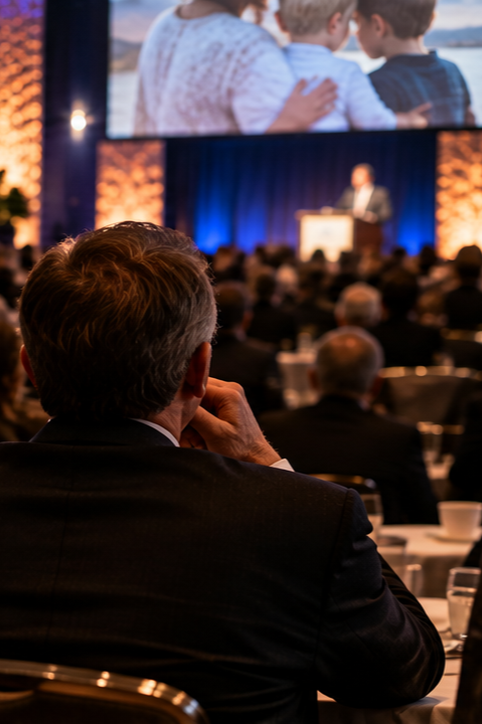
In 1998, I attended the annual meeting of the Million Dollar Round Table, an international organization of successful life insurance and financial professionals. The gathering was held that year at a large convention center in Chicago.
Approximately 7,000 people were in attendance, representing more than 200 insurance companies.
I was there as an honored guest.
The morning platform sessions were famous for their emotional and inspirational presentations, and the audience came prepared to be moved.
One of the main presentations was delivered by David Woods, CEO of an industry association that promoted public understanding of the importance of life insurance.
During his presentation, David showed a professionally produced video about a young family with two small children who had tragically lost their father in an automobile accident.
He had been killed only two days after applying for a life insurance policy.
The young widow talked about her husband. The children spoke emotionally about their dad.
Then the widow explained that the life insurance proceeds had saved her family from financial ruin. They were able to remain in their home, maintain some financial stability, and provide for the children’s future education.
There wasn’t a dry eye in the house.
The video powerfully reminded the thousands of insurance professionals in attendance that our work mattered.
But the tears streaming down my face were for an entirely different and intensely private reason.
You see, I knew the rest of the story.
And no one else in that enormous room did.
As I watched the video, the circumstances surrounding this family began to sound strangely familiar.
Then the family’s insurance agent appeared on the screen. He was a New York Life agent/
Suddenly I knew what I suspected was true.
This case had come across my desk at New York Life several months earlier.
As president of the company, I almost never made decisions on individual death claims. Those decisions were normally handled several levels below me.
But this case was different.
The legal department had brought it to my attention because our lawyers believed New York Life was not legally required to pay the claim.
The deceased man’s application had not been submitted with his initial premium payment. Under the applicable insurance law, his coverage technically was not yet in force when he died.
Our lawyers recommended that I deny the claim.
They were concerned that payment might establish a precedent extending beyond our contractual obligation.
Legally, their reasoning was sound.
But there was one extraordinary circumstance.
The man who had been killed had written and signed a check payable to New York Life for the initial premium.
That check was sitting on his desk at home when he died.
When the case came to me, I didn't read the entire file. I knew almost nothing about the widow. I knew nothing about the two children.
For me, at that moment, it was a business decision.

I thought about the financial loss to the company if we paid the claim. I thought about the possible precedent.
But ultimately I reached a simple conclusion.
Paying the claim was the right thing to do.
So I approved it.
I signed the claim and went on with my work.
I never expected to hear about the case again.
Months later, I was sitting among 7,000 people in Chicago watching that very family tell its story on a giant screen.
Consider the circumstances.
More than 200 insurance companies were represented at that meeting.
Thousands of agents in attendance had handled countless insurance policies and death claims.
The organizers could have chosen any number of stories to illustrate the importance of life insurance.
But they chose this family.
This claim.
This decision.
And among those 7,000 people sat the one executive who knew what had actually happened behind the scenes.
Me.
The statistical improbability was extraordinary.
But timing made the experience even more remarkable.
At that point in my career, I had been questioning the value of what I was doing with my life.
The demands of my job were enormous. I frequently bemoaned the sacrifices I was making in my own family life to carry such a large vocational responsibility.
Was it worth it?
Was my work important enough to justify the price?
Was I really making a difference?
And then, without requesting it and without anticipating it, I found myself staring at the answer on a giant screen in Chicago.
Here’s the miracle.
At precisely the time I was questioning whether my vocation had real meaning, I was shown the lives of a widow and two children whose future had been altered by one decision that had reached my desk.
In the first version of this story, I wrote that God had chosen this venue and this story to reassure me.
I believe that even more strongly today.
But today I would express it more personally.
I believe Jesus Christ knew exactly what was going on in my heart.
He knew my doubts. He knew my exhaustion. He knew the tension I felt between my responsibility to my company and my responsibility to my family.
And He knew precisely what I needed to see.
There were no flashing lights.
No voice came from heaven.
Nothing supernatural occurred in the conventional sense.
But if a miracle can include an extraordinarily improbable event, occurring at precisely the right moment, delivering precisely the message that someone desperately needs to receive, then I have little difficulty calling what happened in Chicago miraculous.
The message was about more than my career.
It was also about integrity.
Months before, when the claim had reached my desk, our lawyers had given me a legitimate technical basis for denying it.
But something told me that paying the claim was right.
Looking back through the lens of my Christian faith, I see that decision differently today.
Jesus consistently taught His followers to look beyond legalism to the human being standing behind the rule—to act with mercy, compassion, fairness, and love.
I didn't consciously say, “What would Jesus do?” when the file landed on my desk.
But the values Christ had been forming in me helped shape the decision.
Then, months later, He allowed me to see the human consequences.
A widow could now remain in her home.
Children had greater security.
A grieving family was spared financial ruin.
That experience changed me.
I subsequently told the story to thousands of New York Life agents and employees. It gave me an opportunity to explain not only the importance of our work, but the importance of doing what is right even when a technical argument might permit us to do otherwise.
And it gave me an opportunity to express my faith.
The greatest change, however, occurred within me.
I became more attentive.
I began watching more carefully for the possibility that God might communicate through circumstances, people, timing, and events that at first glance might appear coincidental.
Over the years, I have learned that answers from Christ seldom arrive the way I expect them to.
But they arrive.
His message in Chicago was one I desperately needed to hear.
And He found the perfect way to deliver it.
For Reflection
You have searched me, Lord, and you know me.
You know when I sit and when I rise;
you perceive my thoughts from afar.
You discern my going out and my lying down;
you are familiar with all my ways.
Before a word is on my tongue you,
Lord, know it completely.
You hem me in behind and before,
and you lay your hand upon me.
Such knowledge is too wonderful for me,
too lofty for me to attain.
Where can I go from your Spirit?
Where can I flee from your presence?
If I go up to the heavens, you are there;
if I make my bed in the depths, you are there.
If I rise on the wings of the dawn,
if I settle on the far side of the sea,
even there your hand will guide me,
your right hand will hold me fast.
Psalm 139:1–10
The experience in Chicago remains one of the most moving of my life.
It came when I needed vocational reassurance and spiritual encouragement. Sitting among 7,000 people, I felt that God knew exactly what was troubling me and had arranged an extraordinary sequence of circumstances to answer.
Today I understand that assurance through my relationship with Jesus Christ.
Christ knows us intimately. He knows the questions we have not voiced. He understands fears we may not even have admitted to ourselves.
“Before a word is on my tongue,” the Psalmist wrote, “you, Lord, know it completely.”
That is exactly how the Chicago experience felt to me.
There will be times in your own life when you struggle with difficult decisions or question your purpose.
Pray.
Then pay attention.
Your answer may not arrive audibly. Mine rarely has.
Watch instead for the unexpected person, the improbable encounter, the perfectly timed telephone call, the unusual circumstance, or the event that seems to answer a question only you and Christ knew you were asking.
Not every coincidence is a miracle.
But I no longer believe every extraordinary coincidence should be dismissed as coincidence either.
Sometimes His hand really is guiding us and holding us fast.